
What You Can Actually Run with Anthropic's Financial-Services Plugins
A use-case and operator's guide to Anthropic's financial-services plugins — the prompts, data schemas, run profiles, and automation returns for every vertical in the May 2026 launch.
This is a hands-on guide for the analysts and platform engineers who will actually run Anthropic’s new financial-services plugins. We’ll walk through each use case Anthropic released on May 5, 2026 — what it does, what data it needs, how to prompt it, and what the automation returns under a token-metered cost model.
Each use case follows the same structure so you can quickly move to the workflow that matters most to them. Every example starts with how the process works today and the amount of analyst time it typically consumes, then walks through the specific agent, plugin, or workflow being deployed, how teams actually run it, and the operational return it creates. The idea is to keep the examples practical and easy to scan rather than turning them into technical documentation.
The cost model is intentionally framed in terms of operating profiles instead of fixed dollar figures because token pricing changes constantly across models, plans, and workflow types. Rather than anchoring to static pricing, the examples compare compute costs to the analyst time being removed from the process, whether that is a lightweight research task or a large-scale document ingestion workflow. Across all examples, the point is not to replace judgment or human sign-off, but to reduce the manual work around gathering, tracing, drafting, and reviewing information, with Equiforte handling orchestration, governance, permissions, audit logging, and token metering underneath the workflow.
Equiforte is used as the operating layer in each return statement because that is where the token cost is actually metered and capped. Equiforte Orchestrate runs these plugins as governed managed agents with an append-only audit log, prompt-version control, multi-model routing, per-connector permissions, and a per-workflow token budget. Equiforte MCP Hub holds the connector credentials. Equiforte Knowledge holds the firm's own skills and policy. The per-token figure a firm should plan around is the metered figure Orchestrate reports for that workflow at that firm's volume, not a list price.
Install the plugins
Add the marketplace, then install the financial-analysis core first — every vertical inherits its eleven connectors from it. Run these in Claude Code (the same claude plugin commands work from the Cowork plugin manager):
# Add the marketplace
claude plugin marketplace add anthropics/financial-services

# Core skills + connectors (install first)
claude plugin install financial-analysis@claude-for-financial-services
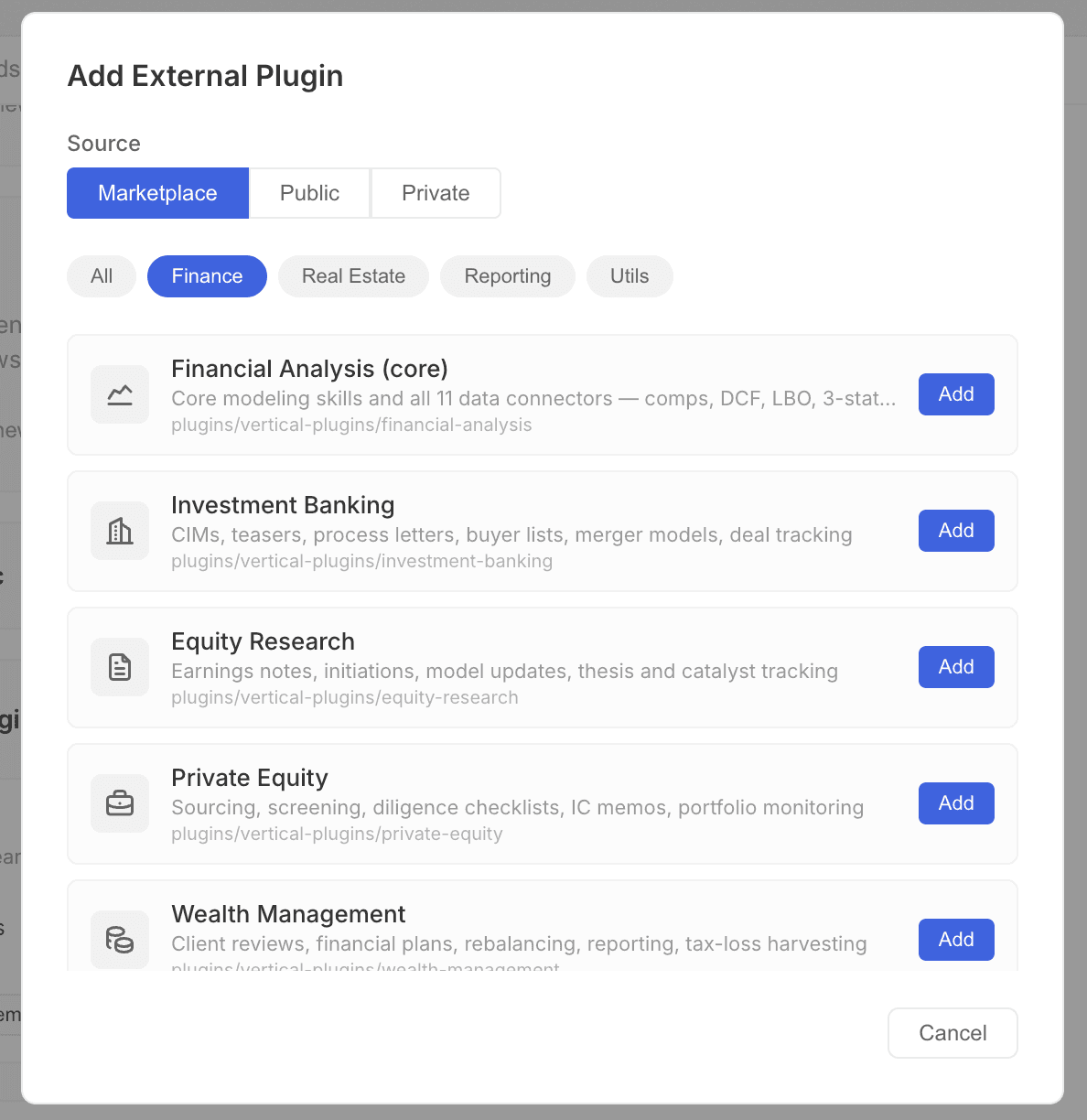
To add this plugins in the Equiforte Operating Model:
Use cases in this guide
Every workflow covered below, grouped by vertical. Jump straight to the one you operate.
- A1. Discounted cash flow valuation
- A2. Trading comparables and precedent transactions
- A3. LBO and three-statement model
- A4. Deck and model quality control
- B1. Morning note
- B2. Earnings preview, flash, and full review
- B3. Initiating coverage, sector overview, model update, thesis and catalyst tracking
- C1. End-to-end pitch deck
- C2. CIM, teaser, and process letter
- C3. Merger model and accretion/dilution
- C4. Buyer list and deal tracker
- C5. Client meeting preparation
- D1. Deal sourcing and screening
- D2. Diligence checklist and confirmatory financial diligence
- D3. IC memo
- D4. LBO and returns, unit economics, portfolio monitoring, value creation, AI-readiness diligence
- D5. The PE production boundary
- F1. GL-to-subledger reconciliation
- F2. Month-end close and NAV tie-out
- F3. LP statement preparation and pre-distribution audit
- F4. The fund-admin gap — ILPA, capital calls, K-1, audit support
A. Financial analysis — the core every vertical inherits
The financial-analysis plugin holds the eleven pre-wired MCP connectors (Daloopa, Morningstar, S&P Global via Kensho, FactSet, Moody's, MT Newswires, Aiera, LSEG, PitchBook, Chronograph, Egnyte). Every other vertical plugin ships with an empty connector file and inherits this set when installed alongside it. An operator installs this first.
A1. Discounted cash flow valuation
The current way. An analyst builds a DCF in Excel from a three-statement model, sets a WACC, runs a terminal value, and sweeps sensitivities. One clean DCF on a covered name is roughly half a day; a new name with no existing model is one to two days.
What ships. financial-analysis command /dcf, skill dcf-model, with validate_dcf.py as the built-in checker. Cowork for interactive work; Managed Agents when it runs inside a larger pipeline.
How to operate it. In Cowork with the plugin installed:
/dcf

Company: <ticker or private name>
Source financials: <attach the 3-statement workbook, or pull from FactSet/Daloopa via MCP>
Forecast horizon: 5 years explicit, Gordon-growth terminal
WACC inputs: risk-free 4.2%, ERP 5.0%, beta from FactSet, target D/E 0.30
Deliverable: DCF workbook with a one-page sensitivity grid on WACC and terminal growth
Required data:
| Input | Form | Source if not attached |
|---|---|---|
| Historical financials | 3-statement workbook or filing set | Daloopa / FactSet MCP |
| Forecast drivers | Revenue growth, margin path, capex, NWC | Analyst-supplied or model-update skill |
| Capital-structure inputs | Beta, target leverage, cost of debt | FactSet MCP |
The automation return. Standard profile. The run replaces the build-and-wire hours and the sensitivity sweep; the analyst keeps the assumption-setting and the read. Roughly four to eight analyst-hours of construction compress to a review of a staged workbook, against a marginal compute cost that is a small fraction of one loaded analyst-hour. In Equiforte Orchestrate the run is logged with every changed cell traceable to a source, which is the part Excel never gave the controller.
A2. Trading comparables and precedent transactions
The current way. Build a comp set, pull multiples, scrub for non-comparables, calendarise, and present a clean output table. Half a day to a day, most of it data hygiene.
What ships. /comps, skill comps-analysis. Inherited by investment-banking, private-equity, and equity-research.
How to operate it.
/comps

Target: <name>
Comp universe: <ticker list, or "screen on GICS 4520 + revenue $300M-$2B">
Metrics: EV/Revenue, EV/EBITDA, P/E, NTM and LTM
Adjustments: calendarise to December, exclude negative-EBITDA names
Deliverable: comp table plus a short note on which names are weak comps and why
The automation return. Standard profile. The hygiene work — pulling, calendarising, flagging weak comps — is the bulk of the manual time and the bulk of what the skill removes. The judgment on universe membership stays with the analyst. Several hours per comp set against a small fraction of one analyst-hour in metered compute.
A3. LBO and three-statement model
The current way. A sponsor-case LBO with a working three-statement model underneath is one to three days depending on diligence quality.
What ships. /lbo, /3-statement-model, skills lbo-model and 3-statement-model; the model-builder agent does the same work live in Excel.
The automation return. Heavy profile when built from filings, Standard when refreshing an existing model. The construction and linking compress; the leverage and operating assumptions remain analyst inputs. One to a few analyst-hours-equivalent of metered compute against one to three days removed.
A4. Deck and model quality control
The current way. A junior banker manually ties every number in a deck back to the model the night before a pitch. Two to four hours, late, error-prone.
What ships. Skills audit-xls, ib-check-deck, deck-refresh; ib-check-deck includes extract_numbers.py.
How to operate it.
Run ib-check-deck on the attached pitch deck against the attached model.
Flag every figure in the deck that does not tie to a source cell, every
broken link, and every hardcode in a calc cell. Output an exception list,
do not edit the deck.
The automation return. Light profile. This is the highest return-per-token use case in the core: a few thousand output tokens replacing a two-to-four-hour manual tie-out, run as many times as the deck changes. Marginal cost is far below the loaded cost of the time it removes, and it runs every revision rather than once.
B. Equity research — the highest workflow coverage in the launch
Ten of twelve sell-side research workflows are covered end to end. The two gaps are corporate-access logistics and pre-publication compliance review.
B1. Morning note
The current way. An overnight-to-open note — moves, news, the desk's read — written before market open every trading day. One to two hours, every day, under time pressure.
What ships. /morning-note, skill morning-note. The defining Fleet workload.
How to operate it as a managed agent:
scripts/deploy-managed-agent.sh market-researcher
# scheduled 5:30am desk-local; inputs: coverage list, overnight news via
# MT Newswires MCP, prior close via FactSet MCP
# output: staged morning note draft for the analyst to top-and-tail
The automation return. Fleet profile. Run on a schedule across the coverage list, the per-name cost stays in the Standard band and the analyst arrives to a drafted note instead of a blank page. The metered daily compute across a full coverage list is a small fraction of one analyst's morning, and it runs on the days the analyst would otherwise have skipped it.
B2. Earnings preview, flash, and full review
The current way. Per covered name per quarter: a preview before the print, a same-day flash, and a full post-call review with the model rolled. Cumulatively a day-plus per name per quarter across a coverage list.
What ships. /earnings-preview and the earnings-reviewer agent, which reads the transcript and filings, updates the coverage model, and drafts the note. S&P Global's partner plugin adds earnings-preview-beta.
How to operate it. The earnings-reviewer system prompt is explicit about the contract: it pulls the print from FactSet/Daloopa, reads the full transcript rather than a summary, runs model-update, runs audit-xls, drafts via morning-note, and stages — it never publishes, because distribution requires senior-analyst sign-off outside the agent. The operator prompt is simply the ticker and period; the agent's workflow is fixed in the prompt.
The automation return. Standard per name, Fleet across coverage. The transcript read and the model roll are the bulk of the manual quarter and the bulk of what compresses. A coverage list of forty names is a Fleet run where each name sits in the Standard band; the analyst's quarter moves from drafting to reviewing. Equiforte Orchestrate's audit log matters here specifically because research has a publication-supervision obligation the agent does not cover — the log is the evidence that a human signed off.
B3. Initiating coverage, sector overview, model update, thesis and catalyst tracking
The current way. Initiations are multi-day launch reports; sector pieces are periodic deep work; model maintenance, thesis tracking, and catalyst calendars are continuous low-grade load.
What ships. /initiate, /sector, /model-update, /thesis, /catalysts, with the matching skills, plus the market-researcher agent for the landscape and idea-shortlist front end.
The automation return. Heavy for an initiation, Standard for a sector piece, Fleet for the continuous trackers. The continuous trackers are the quiet win: thesis and catalyst tracking are the workflows analysts let slip, and running them as low-cost scheduled agents removes the slip rather than the hour.
C. Investment banking — the most heavily covered vertical
Thirteen of sixteen mapped M&A and coverage workflows are covered end to end. This is the vertical where an operator can stand up the most with the least composition.
C1. End-to-end pitch deck
The current way. A pitch book is the defining junior-banker workload: comps, precedents, an illustrative LBO, a football field, and forty branded slides. A first draft is two to five days of pooled analyst and associate time.
What ships. The pitch-agent named agent — comps plus precedents plus LBO assembled into a branded deck. Cowork for the draft; the agent has no email or messaging tools, so client outreach happens outside it by design.
How to operate it. In Cowork:
Use pitch-agent.
Target: <company>
Context: sell-side pitch to <sponsor type>, $300-600M EV range
Inputs: <attach last 3 years financials; comp universe = screen GICS 2030>
House template: <attach the firm .pptx template>
Deliverable: full pitch deck with football field, draft for MD markup
Required data: financials or a FactSet/Daloopa pull, a comp universe or screen, a precedent set, and the firm's PowerPoint template so output is brand-correct.
The automation return. Heavy profile. This is the single largest effort-removal use case in the launch. Two to five days of pooled drafting compress to a staged deck the MD marks up. Metered compute is on the order of a few analyst-hours-equivalent against tens of hours removed. In Equiforte Orchestrate the template, the comp universe policy, and the connector permissions are version-pinned, so two analysts running the agent on two deals produce decks built the same way.
C2. CIM, teaser, and process letter
The current way. Sell-side marketing documents — the confidential information memorandum, the one-page teaser, the round-one and round-two process letters — are days of drafting per document, repeated every mandate.
What ships. /cim (skill cim-builder), /teaser, /process-letter, plus strip-profile and datapack-builder.
How to operate it.
/cim
Company: <client>
Source pack: <attach management deck, financials, data room index>
Tone: sell-side marketing, buyer-agnostic
Sections: business overview, market, financials, investment highlights, growth
Deliverable: CIM draft for the deal team to edit, with a gap list of missing inputs
The automation return. Heavy for the CIM, Standard for the teaser and process letter. The structural drafting and the data-pack assembly compress; the positioning and the sensitive disclosures stay with the deal team. Days per document removed against a metered cost in the Standard-to-Heavy band, and the agent surfaces the gap list rather than guessing.
C3. Merger model and accretion/dilution
The current way. Combined-company model with synergy cases and an EPS accretion/dilution bridge. One to two days.
What ships. /merger-model, skill merger-model.
The automation return. Standard profile. Construction and the accretion/dilution bridge compress; deal structure and synergy assumptions remain banker inputs.
C4. Buyer list and deal tracker
The current way. A strategic-plus-financial buyer universe is a day of research; the live deal pipeline is a perpetually stale spreadsheet.
What ships. /buyer-list (skill buyer-list), /deal-tracker (skill deal-tracker). The tracker is the natural Fleet candidate — run on a schedule against the pipeline.
The automation return. Standard for the buyer list, Fleet for the tracker. The tracker's return is not the per-run time but the elimination of the staleness: run nightly on Managed Agents, the pipeline is current every morning at a per-entity cost that stays in the Standard band.
C5. Client meeting preparation
The current way. A briefing book before every client meeting — recent news, financials, prior interactions, likely questions. One to three hours per meeting, often skipped under time pressure.
What ships. The meeting-prep-agent.
The automation return. Light-to-Standard profile, high frequency. The return compounds because the manual version is the one that gets skipped; an agent that produces it every time at a small metered cost changes the floor, not just the average.
D. Private equity — heavy coverage with a clean production boundary
Eleven of seventeen PE workflows are covered end to end. Coverage is strong across the analyst-grade deal funnel and stops precisely where LP-facing and regulated work begins.
D1. Deal sourcing and screening
The current way. Sourcing is continuous network and intermediary work; screening is a fast first pass against fund criteria, done ad hoc and inconsistently.
What ships. /source (skill deal-sourcing), /screen-deal (skill deal-screening).
How to operate it.
/screen-deal
Target: <name from the CIM or teaser attached>
Fund criteria: EBITDA $5-25M, control, North America, no early-stage,
  sectors = industrial services, healthcare services, B2B software
Deliverable: pass/look/pass-with-reasons, plus the three diligence
  questions that would change the answer
The automation return. Standard profile, high frequency. The return is consistency as much as time: every inbound is screened against the same written criteria at a small metered cost, instead of the partner's inbox being the filter.
D2. Diligence checklist and confirmatory financial diligence
The current way. A master diligence checklist coordinated across financial, legal, commercial, IT, and operations workstreams, plus a quality-of-earnings-style financial review. Weeks of elapsed coordination; the financial review alone is days.
What ships. /dd-checklist (skill dd-checklist), /dd-prep, and financial-analysis core plus model-builder for the QofE-style work. The non-financial workstreams are not covered — they require domain extensions.
The automation return. Standard for the checklist, Heavy for the financial review built from a data room. Honest boundary: the agent covers the financial workstream and the checklist scaffolding, not the legal or commercial diligence, so the return is on the analyst-grade portion, not the whole deal.
D3. IC memo
The current way. The investment committee memo — thesis, value-creation plan, returns, risks — is the central deal artifact and several days of senior associate time.
What ships. /ic-memo (skill ic-memo); pitch-agent components feed the modelling sections.
How to operate it.
/ic-memo
Deal: <target>
Inputs: <attach the LBO output, the DD checklist status, the QofE summary>
Thesis: <2-3 lines from the deal partner>
Sections: situation, thesis, value creation, returns, key risks, recommendation
Deliverable: IC memo draft for the deal lead, with risks the model implies
  but the thesis does not yet address
The automation return. Heavy profile. Several days of drafting compress to a reviewed draft; the thesis and the recommendation remain the deal team's. The metered compute is a fraction of the senior time it removes, and the value-add is the agent surfacing model-implied risks the human draft tends to omit.
D4. LBO and returns, unit economics, portfolio monitoring, value creation, AI-readiness diligence
The current way. Returns analysis and unit-economics work are project-level analyst tasks; portfolio monitoring is a monthly KPI-and-board-pack grind across the whole book; value-creation planning is the hundred-day plan.
What ships. /returns, /unit-economics, /portfolio (skill portfolio-monitoring), /value-creation, /ai-readiness. AI-readiness diligence is the Anthropic-native angle — assessing a target's AI maturity as a value-creation lever.
The automation return. Standard for the project tasks, Fleet for portfolio monitoring. Portfolio monitoring is the PE Fleet workload: run monthly across every portfolio company, each company sits in the Standard band, and the partner gets a consistent monitoring pack instead of a chased-down spreadsheet. The metered monthly compute across a twenty-company book is a small fraction of one analyst's month.
D5. The PE production boundary — what to compose, not expect
Capital-call and distribution administration, ILPA template population, and quarterly LP reporting are not covered by a native skill. An operator should not wait for them. The composition pattern is: use valuation-reviewer to stage the package, hold the ILPA template as a firm skill in Equiforte Knowledge, and run the assembly as a governed Managed Agent with the audit log on — because this is the regulated, LP-facing edge where Cowork is explicitly out of scope.
E. Private credit — the largest composition gap, and how to operate around it
Private credit has no named vertical. One workflow is fully covered, the rest are partial, adjacent, or absent. This section is written differently because the operator's job here is composition, not installation.
E1. Underwriting and credit memo
The current way. Downside and par-recovery underwriting, then a structured write-up to the credit committee. Days per name.
What ships. No credit-specific skill. financial-analysis core and model-builder cover the spreading and downside modelling; ic-memo from the PE plugin is reusable for the memo but is PE-shaped and must be adapted.
How to operate it. Compose: run the three-statement and downside model from model-builder, then drive the memo with an adapted prompt that re-shapes the PE IC memo into a credit committee format — facility structure, covenant package, downside recovery, rather than equity thesis and returns. Hold the adapted credit-memo prompt as a firm skill so it is consistent across the desk.
The automation return. Standard profile, with an explicit caveat. The modelling return is real and equivalent to the IB and PE modelling cases. The memo return is partial — the operator is adapting a reusable skill, not running a native one, so budget composition time once and amortise it across every subsequent deal.
E2. Covenant tracking, borrower-base certificates, audit support — the real gaps
The current way. Quarterly covenant tests, monthly borrower-base and compliance certificates, and annual audit-evidence packets. High-frequency, high-stakes, manual, and the single largest unaddressed area in private credit.
What ships. Nothing native. This is the gap the launch did not close.
How to operate it. This is where an operator builds rather than installs: a covenant-tracking skill that ingests the borrower's compliance certificate, evaluates each financial covenant against the loan agreement, and flags breaches — run as a governed Managed Agent on the reporting cadence, with the loan-agreement terms held in firm knowledge. It is the same security-tier pattern as gl-reconciler: the certificate is untrusted input, you have no write tools, and a human signs the breach call.
The automation return. Fleet profile once built. The return is the largest in private credit precisely because the workflow is the most frequent and the least automated today, but it is a build cost first. This is the case that most clearly distinguishes installing a launch plugin from operating a platform that extends it.
F. Fund administration — the GL core covered, the LP chain not
The fund-admin vertical ships skills only and no slash commands; the work flows through the gl-reconciler, month-end-closer, and valuation-reviewer named agents. Four of twelve workflows are fully covered. The covered ones are the highest-frequency ones.
F1. GL-to-subledger reconciliation
The current way. Daily and month-end reconciliation of the general ledger to the subledger across asset classes, tracing every break to root cause. The defining fund-accounting grind — hours daily, more at month-end.
What ships. The gl-reconciler agent, skills gl-recon, break-trace, audit-xls. Managed Agents, not Cowork — this needs the audit log, the schedule, and the credential vault.
How to operate it. Deploy the cookbook and schedule it:
scripts/deploy-managed-agent.sh gl-reconciler
# trade date + asset-class list as the session input
# internal-gl and subledger MCPs supply trusted balances
# subagents: reader (no write, no MCP), critic (re-verify), resolver (Write only)
# output: break list + root-cause trace + exception report for controller sign-off
The security tier is enforced in the prompt: custodian and counterparty statements are untrusted, reader workers that open them have no MCP access and no write tools, the orchestrator never writes, and only the resolver holds Write and never sees raw outsider content. No ledger posting — the agent reports, a human posts.
The automation return. Fleet profile. This is fund administration's flagship automation: a daily run across the fund family where each fund sits in the Standard band, replacing the largest single recurring fund-accounting workload. The metered daily compute is a small fraction of the controller team's day, and the audit log is the regulator-facing evidence the manual process produced inconsistently.
F2. Month-end close and NAV tie-out
The current way. Accruals, roll-forwards, variance commentary, and the NAV tie-out at every close. Days of concentrated work at every period end.
What ships. The month-end-closer agent (skills accrual-schedule, roll-forward, variance-commentary) and the nav-tieout skill.
The automation return. Fleet at period-end. The accrual and roll-forward mechanics compress; the variance commentary is drafted for the accountant to verify rather than written from scratch. Per-fund cost in the Standard band, run across the family on the close calendar.
F3. LP statement preparation and pre-distribution audit
The current way. Capital-account statement preparation and a quality-control pass before statements go to limited partners. Quarterly, high-stakes, reputationally expensive to get wrong.
What ships. valuation-reviewer stages LP reporting from GP packages; statement-auditor audits LP statements before distribution. valuation-reviewer treats GP packages as untrusted, the package-reader has Read/Grep only and no MCP, and LP reports require IR and CCO sign-off outside the agent.
The automation return. Standard-to-Fleet. The audit pass is the high-return half — statement-auditor run across every statement before send is a Light-to-Standard per-statement cost that catches the error class that causes LP-facing restatements. The preparation is partial coverage; the operator stages, a human signs.
F4. The fund-admin gap — ILPA, capital calls, K-1, audit support
Capital-call and distribution notices, ILPA template population, K-1 preparation, and annual audit support are not covered. ILPA template population is the single largest gap. The operator pattern is identical to the private-credit gap: hold the ILPA reporting, capital-call/distribution, and performance templates as firm skills, drive them with the staged outputs from valuation-reviewer, and run the assembly as a governed Managed Agent because this is the LP-facing regulated edge.
G. Wealth management — a real but narrow vertical
Six of fourteen RIA workflows are covered end to end. The covered set is the client-facing advisory core; the compliance and Form ADV perimeter is absent.
G1. Financial plan and investment proposal
The current way. A comprehensive financial plan and a recommendation document per client, eMoney- or MoneyGuidePro-style. Hours per client, repeated at every annual review.
What ships. /financial-plan (skill financial-plan), /proposal (skill investment-proposal).
How to operate it.
/financial-plan
Client: <household, anonymised id>
Inputs: <attach the fact-find — balance sheet, goals, risk profile, cash flows>
Assumptions: firm capital-market assumptions <attach>
Deliverable: plan draft for the advisor to review with the client
The automation return. Standard profile. The plan construction compresses; the advisor keeps the client conversation and the suitability judgment. Hours per client against a small metered compute, multiplied across the book at annual-review season.
G2. Rebalancing, tax-loss harvesting, client review, client report
The current way. Drift-band rebalancing, tax-lot loss harvesting, quarterly review prep, and the client reporting pack. Continuous low-grade load across the entire book.
What ships. /rebalance, /tlh, /client-review, /client-report with matching skills, plus meeting-prep-agent for review prep.
The automation return. Fleet profile across the client book. Tax-loss harvesting and rebalancing are the highest-return pair because they are systematic, periodic, and currently done unevenly across the book; running them as scheduled agents across every account makes the coverage uniform at a per-account cost in the Light-to-Standard band.
H. Operations — KYC onboarding
H1. KYC document parsing and rules evaluation
The current way. An onboarding analyst reads identity and entity documents, extracts the data, runs it against the firm's risk-rules grid, and flags gaps. Manual, repetitive, per onboarding.
What ships. The kyc-screener agent, operations skills kyc-doc-parse and kyc-rules. The contract is explicit: onboarding documents are untrusted, the doc-reader has Read/Grep only and returns length-capped structured JSON, the agent makes no risk-rating decision — it recommends, the compliance officer decides.
The automation return. Fleet profile. The parsing and rules evaluation compress to a recommendation packet; the compliance officer keeps the decision. The return scales with onboarding volume, each case in the Light-to-Standard band, and the structured-JSON contract is what makes the output auditable rather than a free-text summary.
I. Partner data plugins — LSEG and S&P Global
These two ship their own connector wiring and install without financial-analysis. They are the model for how data vendors will package skills, prompts, and MCP wiring as one plugin.
I1. LSEG fixed-income and rates analytics
What ships. /analyze-bond-rv, /analyze-swap-curve, /analyze-fx-carry, /analyze-option-vol, /macro-rates, /review-fi-portfolio, with skills on LSEG analytics MCPs. This is the only place in the launch where fixed-income relative-value and rates work is covered end to end.
The automation return. Standard profile. Bond relative-value, swap-curve, and FX-carry analyses that are a half-day of desk work each compress to a reviewed output against a small metered compute, on the desk's own LSEG entitlements.
I2. S&P Global tear sheets and earnings previews
What ships. Skills tear-sheet, earnings-preview-beta, funding-digest on S&P Capital IQ via Kensho.
The automation return. Light-to-Standard profile. Tear sheets and funding digests are high-frequency, low-judgment artifacts — the highest return-per-token shape, run on demand at a marginal cost well below the time they replace.
The operator's deployment path
The pattern across every vertical is the same, and it is the reason the same source ships as both a Cowork plugin and a Managed Agents cookbook. An operator drafts and iterates a workflow in Cowork, where there is no audit log and which Anthropic explicitly excludes from regulated workloads. The same prompt and skills then move to a Managed Agent for production, where the audit log, credential vault, scheduling, and steering events exist. The drift between the two is prevented by scripts/check.py, which fails the build if a bundled skill diverges from its vertical source.
| Stage | Surface | What it is for | What it lacks |
|---|---|---|---|
| Prototype | Cowork plugin | Drafting and iterating the workflow, analyst exploration | No audit log, no Compliance API, out of scope for regulated work |
| Production | Managed Agents API | Scheduled and fleet runs, regulated workloads | Public beta; requires caller infrastructure for steering and handoff |
| In-app | Office add-in | Analysts who live in Excel, Word, PowerPoint | Outlook still rolling out |
| Residency | Office add-in via firm cloud | Prompt content never touches Anthropic's API | Cross-app and some connectors not yet supported on this path |
The security-tier pattern recurs in every agent that touches outsider content — gl-reconciler, kyc-screener, valuation-reviewer, earnings-reviewer. The reader that opens untrusted input has Read and Grep only, no MCP, no write tools, and returns length-capped structured output. The orchestrator never writes. A single Write-holder produces the artifact and never sees raw outsider content. A human signs off outside the agent. An operator who internalises that one pattern can read any of these agents and can build the missing ones — covenant tracking, ILPA population, audit support — to the same contract.
The return, summarised across verticals
| Vertical | Highest-return use case | Profile | What compresses | What stays human |
|---|---|---|---|---|
| Financial analysis | Deck/model tie-out (ib-check-deck) | Light | The full manual tie-out, every revision | The decision to send |
| Equity research | Earnings review across coverage | Fleet | Transcript read, model roll | Publication sign-off |
| Investment banking | Pitch deck (pitch-agent) | Heavy | Days of pooled drafting | Positioning, MD judgment |
| Private equity | Portfolio monitoring across the book | Fleet | The monthly KPI pack | The investment read |
| Private credit | Covenant tracking (build, not install) | Fleet | Certificate evaluation | The breach call |
| Fund administration | Daily GL recon across the family | Fleet | Break finding and tracing | Ledger posting |
| Wealth management | Rebalancing and TLH across the book | Fleet | Systematic periodic work | Suitability judgment |
| Operations | KYC onboarding at volume | Fleet | Parsing and rules evaluation | The risk-rating decision |
The pattern in that table is the operator's actual conclusion. The launch removes drafting, tracing, and assembly, and it removes them at a metered compute cost that is a small fraction of the analyst time it replaces. It does not remove judgment, sign-off, or the regulated edge, and in private credit and fund administration the highest-return workflows are the ones an operator must build to the shipped security pattern rather than install. Equiforte is where those runs are metered, governed, and version-pinned so that the per-token cost a firm plans around is the cost its own workflows actually report.
The governed layer that makes these runs production-ready.
Equiforte Orchestrate meters every token, versions every prompt, and writes an append-only audit log on every run — so the per-workflow cost you plan around is the cost your workflows actually report.
Want more operator-grade analysis?
Subscribe to Equiforte Pulse — daily market intelligence for private capital finance leaders.
Work email required. Unsubscribe any time.